
Alyvia Herman Presents Poster at URECA Symposium
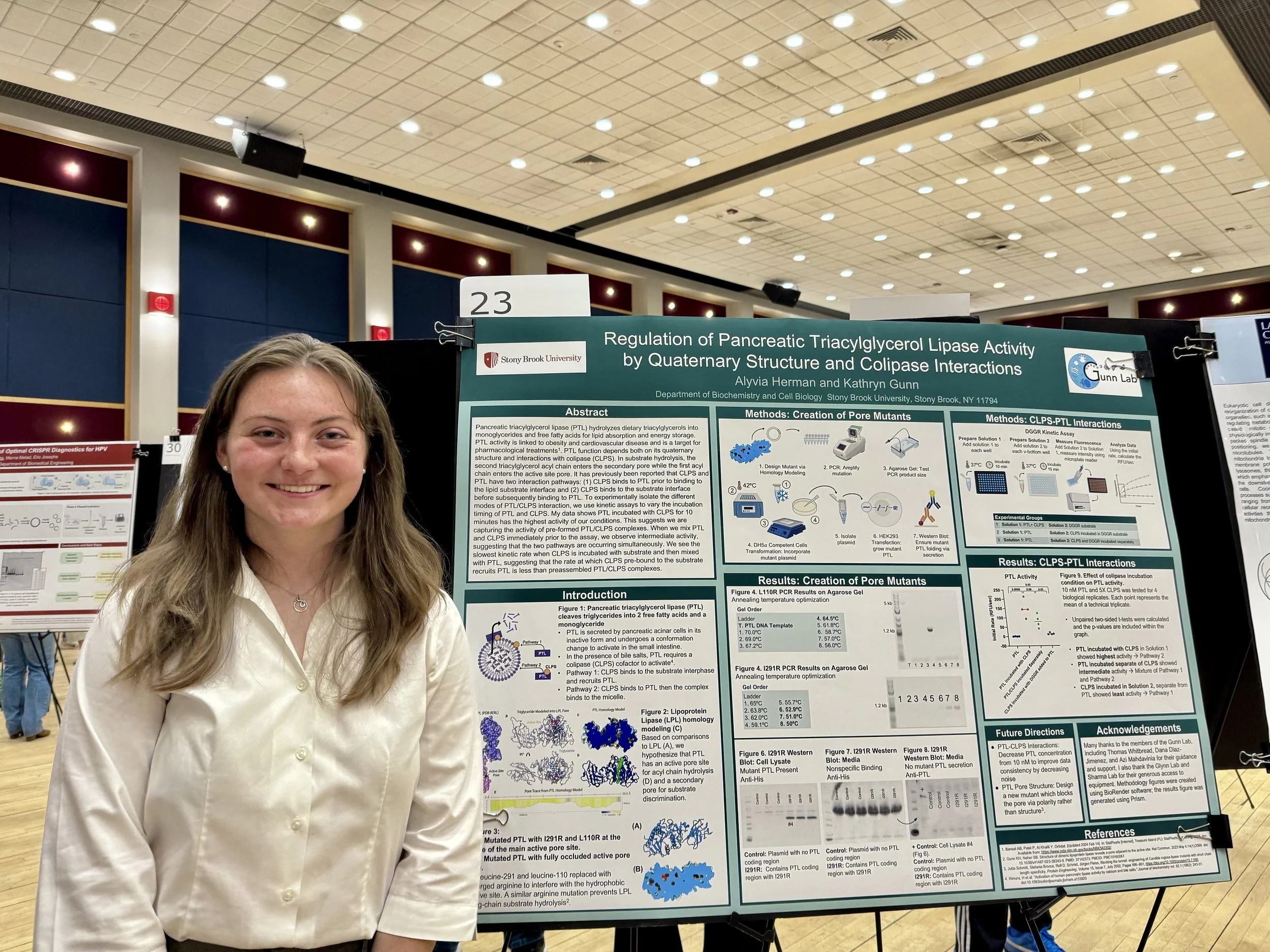
Undergraduate researcher Alyvia Herman of the Gunn Lab at Stony Brook University recently presented her work at the Undergraduate Research & Creative Activities (URECA) Poster Session, sharing her project titled: “Regulation of Pancreatic Triacylglycerol Lipase Activity by Quaternary Structure and Colipase Interactions.”
The URECA poster session highlights the depth and impact of undergraduate research at Stony Brook, and Alyvia’s project exemplified the challenges and ongoing discoveries inherent in biochemical research. Alyvia’s research centers on pancreatic triacylglycerol lipase (PTL), a crucial enzyme responsible for breaking down dietary fats. Its activity is tightly regulated through structural organization and its interaction with colipase (CLPS), a cofactor required for efficient lipid hydrolysis.
Designing Mutants to Explore Enzyme Activity
As part of her project, Alyvia engineered PTL mutants intended to subtly alter the enzyme’s ability to hydrolyze substrates. However, this phase of the project revealed an unexpected but important outcome: the initial mutants failed to properly secrete from cells, preventing further functional analysis through activity assays.
While this result meant that the intended experiments could not proceed as planned, it provided valuable insight into the structural constraints required for PTL stability and secretion. Such results are a common and informative part of experimental science, helping refine hypotheses and guide future directions. Building on these findings, Alyvia is now working to design new PTL mutants with more subtle structural changes. The goal of this next phase is to preserve proper protein folding and secretion while still introducing measurable differences in enzyme activity.
In parallel, her research includes activity assays examining PTL activation by colipase, comparing conditions where the proteins are incubated separately or together to better understand the dynamics of their interaction.
Alyvia’s URECA presentation highlights not only technical skill and scientific curiosity, but also the iterative nature of research. Negative or unexpected results play a critical role in advancing understanding, often leading to more refined and impactful experiments. The Gunn Lab is proud to support undergraduate researchers like Alyvia, whose perseverance and thoughtful approach to experimentation reflect the core values of scientific inquiry.